
How We Grade Every Secondhand Golf Club We Sell
“Good condition.” “Well used.” “Excellent for its age.” If you’ve ever shopped for secondhand golf clubs, you’ve seen these phrases everywhere — and they tell you almost nothing. Here’s the four-point standard we built to fix that, and what it means for your next purchase.
7 MIN READ · THE CLUB GRADING INDEX
Why “Good Condition” Isn’t Good Enough
Search for secondhand golf clubs online and you’ll find the same handful of vague terms repeated across thousands of listings: excellent, very good, good, well used. The trouble is, none of these mean the same thing from one seller to the next. One person’s “excellent” is another’s “good.” A driver described as “well used” could have a perfectly sound face and a scuffed sole, or a cracked shaft and barely-touched paintwork.
For buyers, that ambiguity means guesswork and, too often, disappointment when a club arrives. For sellers and trade-in shops, it means no consistent way to price fairly. And unlike most secondhand goods, golf clubs are performance equipment — a worn face or an unstable shaft doesn’t just look tired, it changes how the club actually plays. A generic three-word condition scale, borrowed from selling secondhand electronics or clothing, was never built with that in mind. We built the Club Grading Index to close that gap — a grading system specific enough that the number on a listing means exactly the same thing every time, on every club, for every customer.


We created this index so you stop worrying about the clubs you buy and spend more time enjoying your time on the course.
Introducing the Club Grading Index
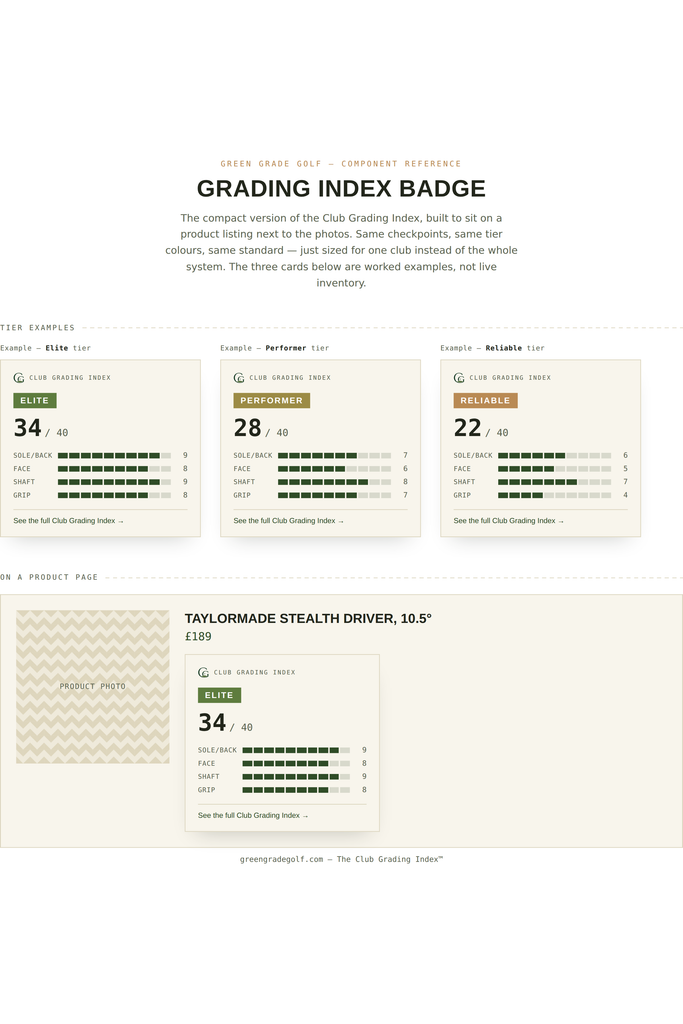
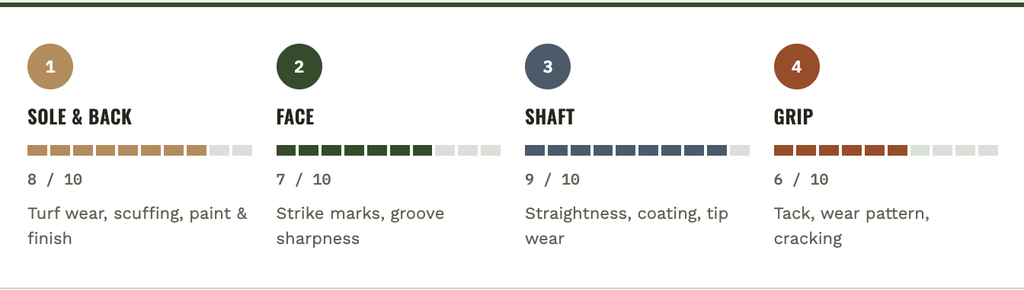
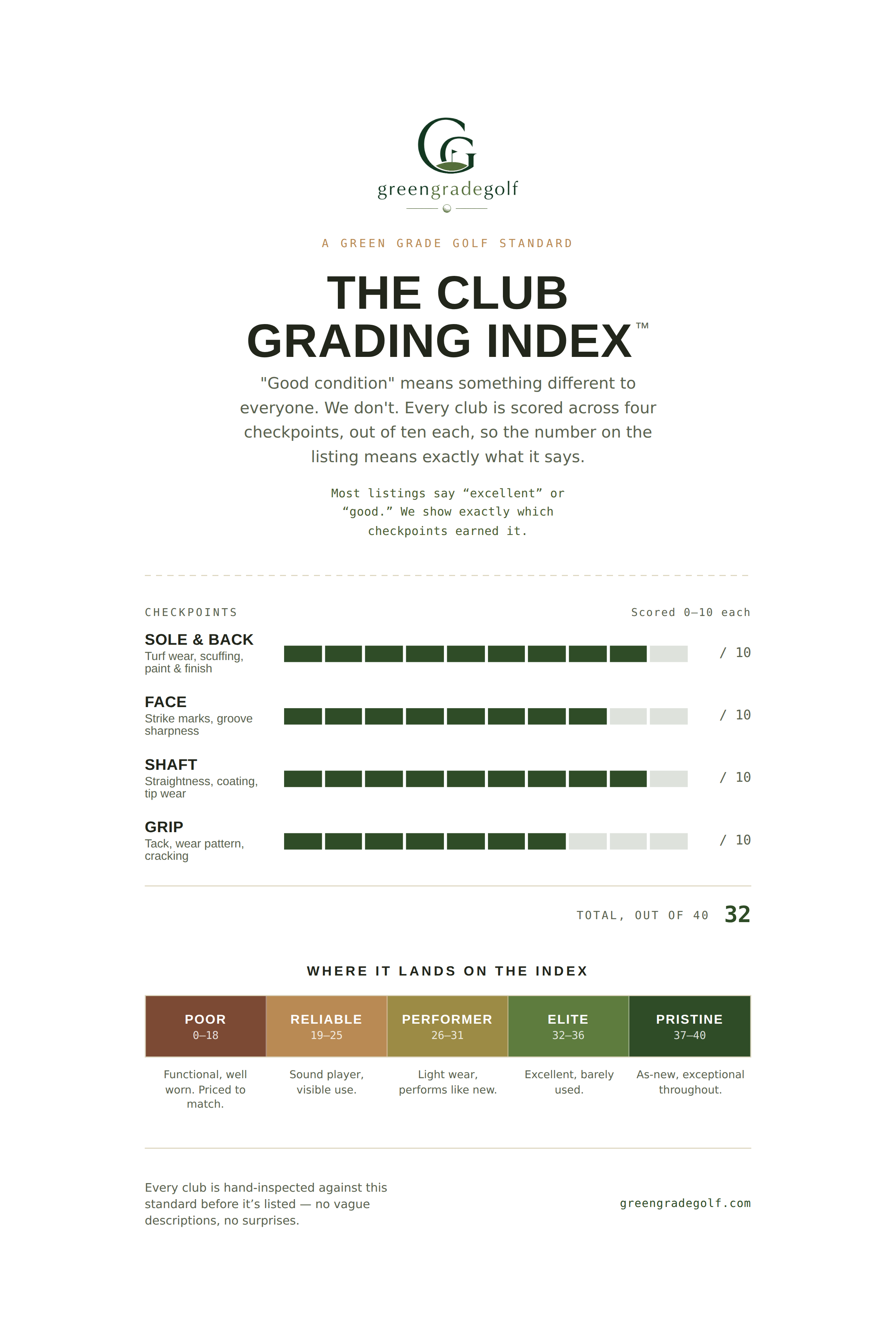
Instead of one vague label, every club we list is scored across four checkpoints, each marked out of 10. The four scores are added together for a total out of 40, and that total places the club into one of five clear condition tiers. From Poor up to Pristine.
Explaining how we grade your second hand equipment
Sole & Back
The part of the club that meets the turf and the ground on every shot. We check for scuffing, deep scratches, and how much of the original paint and finish remains.
Face
Where the ball actually makes contact. This score looks at strike marks and, on irons and wedges, how sharp the grooves still are, both of which can affect spin and feel, not just looks.
Shaft
Checked for straightness, coating condition, and wear near the tip, since a compromised shaft can change how a club performs even if everything else looks fine.
Grip
The easiest part to replace, but still scored, since tack, wear pattern and any cracking affect how the club feels in hand from day one.
From Score to Tier: What the Numbers Mean
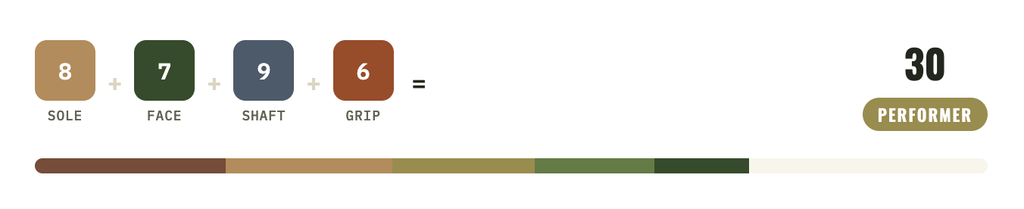
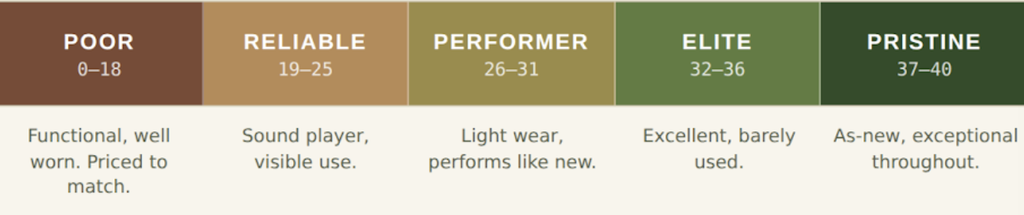
Once the four scores are added up, the total out of 40 places the club into one of five tiers. The bands get tighter as they go up, the higher tiers are deliberately harder to reach, so a club graded Elite or Pristine has genuinely earned it.
What to Expect at Each Grade
A tier isn’t just a label slapped on at the end. It’s a direct result of what the four checkpoints add up to. Here’s what each one actually looks and plays like, and roughly what a club needs to show at each checkpoint to land there.
Poor — 0–18
Typically averaging under 5 out of 10 per checkpoint. Expect visible wear across most areas, scuffing or scratching on the sole, noticeable strike wear on the face, and a grip that’s likely overdue for replacing. Still fully functional and safe to play, just showing its history honestly. Priced to match, and a sensible choice if you want a playable club without paying for cosmetics.
Reliable — 19–25
Averaging around 5–6 per checkpoint. A sound, dependable player. Although wear is visible if you look for it, nothing gets in the way of how the club performs. A practical pick for anyone who’d rather put their budget toward rounds than toward a spotless finish.
Performer — 26–31
Averaging around 6.5–7.5 per checkpoint. Light wear only, and it plays like new. The face and shaft are in strong shape, with any marks mostly limited to the sole and back. This is where most golfers land when they want near-new performance without a near-new price.
Elite — 32–36
Averaging around 8–9 per checkpoint. Excellent condition throughout, grooves still sharp, shaft true and straight, grip with plenty of life left. The kind of club you’d be comfortable handing someone and saying it’s hardly been played.
Pristine — 37–40
Averaging 9–10 per checkpoint. As close to new as a secondhand club gets, with every checkpoint close to flawless. These are rare by design. The bar is set deliberately high, and a club only earns this grade when every single area backs it up.
Because the total comes from four independent scores rather than one overall impression, two clubs in the same tier can still differ slightly from each other. That’s exactly why every listing shows the full checkpoint breakdown, not just the tier name. So you can see precisely where each club stands, not just which bracket it fell into.
Why We Built It This Way
Green Grade Golf started with two goals: make buying secondhand clubs genuinely easy, and pay a fair price when someone trades theirs in. Vague grading got in the way of both. A buyer had no real way to know what “good condition” meant until the club showed up. A seller had no way to know their trade-in offer reflected the actual club, rather than whoever happened to be looking at it that day. Building an explicit, points-based standard, instead of relying on the same handful of adjectives everyone else in secondhand golf uses was the only way to fix both problems at once. None of what follows was arbitrary; each choice solves a specific part of that problem.
Four checkpoints, not one impression
A club can look excellent in a listing photo and still have a compromised face or an unstable shaft. Issues a single overall impression will happily hide. By scoring sole & back, face, shaft and grip independently, a weak area can’t get averaged away by three strong ones. If a club’s grip is tired but everything else is close to new, you’ll see that in the breakdown rather than finding out when it arrives.
A number, not just a word
A single adjective like “good” throws away information the moment it’s written. Adding the four scores together keeps that detail intact, you can always see exactly where a total came from. While the five tiers still give a fast, familiar way to compare clubs at a glance. You get the precision of a score and the readability of a label, instead of having to pick one or the other.
Harder to reach at the top, on purpose
It would be easy to hand out “Elite” and “Pristine” generously. More listings would look impressive, and it would cost us nothing today. We built the bands the opposite way, tightening the range required as the tiers go up, because a grading system only earns trust if its highest grade stays genuinely rare. A club graded Elite or Pristine with us has to clear a higher bar than a looser scale would ever ask for.
How the Club Grading Index Compares to the Rest of the Secondhand Golf Market
Most secondhand golf retailers and marketplaces still grade condition the same way they always have: one broad, subjective word covering the whole club, usually from a short list like Excellent, Good or Fair. It’s quick to write, but it hides more than it tells you a club marked “Good” could have a worn face or nothing worse than a tired grip, and there’s no way to know which until it arrives. Because that judgement is subjective, the same club could reasonably get a different grade from one seller to the next.
| Typical secondhand listing | The Club Grading Index | |
|---|---|---|
| How it’s graded | One overall impression of the whole club | Four checkpoints, scored independently |
| What you see | A single word, e.g. “Good” | A full score breakdown, out of 40 |
| Consistency | Varies from seller to seller | The same fixed points system, every time |
| Top grade means | However generous the seller feels | A deliberately high bar, rarely reached |
That’s the difference the Club Grading Index is built to make: not a nicer-sounding label, but an actual standard behind it. The same four checkpoints, the same scale, applied the same way to every club we sell.
What This Means When You’re Buying or Selling With Us
Every club listed on greengradegolf.com carries its full Club Grading Index breakdown, not just the tier, but all four checkpoint scores behind it. That means you can see, before you buy, exactly why a club scored what it did, rather than trusting a single subjective word.
It works the other way too. If you’re trading in or selling clubs to us, the same standard is what determines your offer. This makes pricing at GreenGradeGolf consistent, checkable rather it being someone’s opinion on the day.
Every club is hand-inspected against this standard before it ever goes live. No vague descriptions, no surprises when the box arrives.